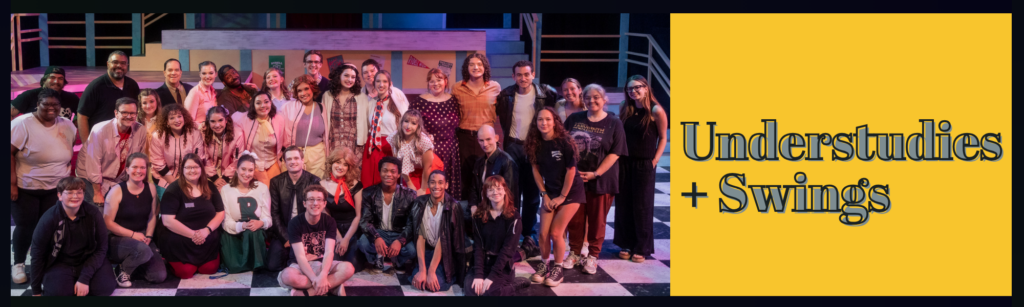
We all know the plot of a movie…The actor who thought they would get the starring role is cast as the now bitter understudy. The star actor is in a “freak accident” and it’s the understudies moment to shine. The understudy captures the attention of the director and outshines the lead.
While these are not realistic, they also aren’t good mentalities to have.
Understudies and swings, in fact, are essential and just as talented as the main cast, potentially with an even more challenging role to play, while memorizing lines, dances, songs, and motions; often for multiple roles.
The Difference
A swing is like the understudy of the understudy. When one actor has to fill in for another, it cascades in need of coverage. However, the understudy does play on stage in the ensemble (the background characters), and the swing does not have a role on stage unless they are filling in for someone in the ensemble who couldn’t be there.
Therefore when the understudy is assigned to know their role and one other main role, the swing learns 12 or more ensemble roles to fill at any time.

From Broadway to community theater, understudies and swings are important parts of stage production as they save a show when someone can’t be present. Every theater has different practice requirements for their understudies and swings.
When casting for an understudy or swing, directors are looking for adaptable and committed actors who can learn and perform multiple roles in varying styles, as well as keep their parts organized.
Some actors specifically audition for an understudy or swing role, while others are chosen from the cast as actors that are fit for the position. However, there is a lot of stigma around being the understudy or swing.
An Understudy
An understudy is casted with the potential to perform the lead role if necessary, but they must do the rehearsal for that main part independently. While they do observe every practice that their main counterpart attends, most of their memorizing and rehearsing happens on their own or with other understudies.
The understudy is assigned to one actor that they could cover on any given notice, and they must learn that role’s lines, songs, dancing, and blocking (the actor’s position on stage, and where they enter, exit, move, face, stand, or sit during a scene). Yet they also must learn and perform their part in the ensemble as well when they aren’t covering for the lead actor.

The understudy isn’t supposed to be an exact copy of the main actor, and they also aren’t supposed to try to do the role differently or “better” as to not throw off the other actors they interact with on stage. To be prepared to do the part but not too eager, is hard to balance and can be described as an “emotional rollercoaster”. To be able to confidently play another part without as frequently rehearsing it can be difficult too.

Morale is important in these moments, to remember that understudies are still a part of the cast and story. And they are the person who is trusted to keep the show from falling apart if one of the main actors cannot attend a performance.
How often an understudy must fill in depends on the size of the cast and how many performances they do, but considering how often people get sick, can’t sing, or have emergencies of any sort could be very possible.
Advice for an understudy:
- Stand up and say your lines when you get the chance to practice them
- Keep observing when you can and take notes
- Learn the part like you will open with it, not maybe play it
- Work together with other understudies, you are in the same position emotionally and practically
Swings
Swings cover more positions and actually get paid more than understudies, even though they don’t perform on stage as often! Learning nearly 12 ensemble parts is very challenging to do, therefore, directors are looking for someone they believe can master many roles.

Swings can be asked to fill in a couple hours before a show, during intermission, or even mid act! However they are expected to be able to perform it without a book in hand and with or without a brush up rehearsal (a brief run through of the show to refresh memory).

Just as the understudies practice independently, swings must teach themselves their parts and practice on their own time. To keep each part organized, many swings have multiple scripts to highlight and block each part.
This is a super challenging skill set to have, but many people have made a career out of it and have been remembered by directors for it. Swings are technically just as good as the rest of the performers, and are the glue that holds the show together when someone can’t play their part.
Advice for swings:
- Being a swing isn’t a bad thing, you are still a good actor and wanted to be there!
- Being a swing is a good way to get your foot in the door, just don’t let your ego get in your way
- You will mess up while performing, but don’t let it get to you
- If there is an empty gap, you’re probably the one that is supposed to fill it!
- Always be practicing your roles backstage while they are performing, so pretend to say the lines, sing along to music, or map out the dance, that way you look you know your part if you have to play it
When planning for the unexpected to happen, understudies and swings are cast as an integral part of a performance. It isn’t easy to do, and we appreciate understudies and swings for their commitment and talent.If you’re cast as an understudy or swing, embrace it fully and be the best one you can be. It’s a chance to stand out, grow in unexpected ways, and learn more than you ever thought possible!